
June 22, 2026
Bringing Your Own Model from Hugging Face to Production: A Complete Workflow
You found a model on Hugging Face that's close to what you need. Twelve weeks later it's still not in production. This is the workflow that gets it shipped — the one most teams reverse-engineer the hard way.
Step 1: Evaluate before you adopt
Before importing, evaluate the candidate model against 100 representative samples from your production data. Three metrics: accuracy, latency, and licensing. Most teams check accuracy and skip the other two. License audits at procurement time will block deployment if the model is non-commercial — check the model card up front.
Latency includes both inference time and cold start. A 200ms cold start on a 100ms model means your first user every minute waits 300ms. Production realities, not benchmarks.
Step 2: Import and host
Pull weights, tokenizer (for multi-modal), and preprocessing config into your platform. Run inference once against your evaluation set to verify reproducibility. This is where most BYOM workflows fail silently — the model that works in a notebook fails in the hosted endpoint because preprocessing is subtly different.
Container the inference path including preprocessing. Pin model and library versions. Tag the container with the model hash so you can trace deployments back to source weights.
Step 3: Use it for AI-assisted labeling
Run the imported model against 5,000 unlabeled production samples. Send the lowest-confidence 500 to annotators. This is the first practical labeled batch from your distribution — and the seeds of your finetuning dataset.
Two cycles of this typically gets you to a usable fine-tuning corpus of 1,500-2,000 samples with the highest information density per labeled image.
Step 4: Fine-tune
Most teams fine-tune incorrectly. Don't replace the entire model — freeze early layers, unfreeze the last 24 layers, and train for 5-15 epochs with a low learning rate. Validate on a held-out set, not on training accuracy.
Compute: most fine-tuning runs for vision models on 2,000 samples complete in 4-10 A100-hours. Plan for two or three fine-tunes per project; the first is rarely the final.
Step 5: Deploy with versioning
Deploy fine-tuned weights as a new model version, not in place. Route 10% of production traffic to the new version for 24 hours, monitor accuracy on the sampled-labeled holdout, then ramp to 100% if metrics hold. This is canary deployment — non-negotiable for production ML.
Step 6: Monitor and close the loop
In production, sample 0.5-2% of inferences for human review. The labeled samples feed back into the dataset for next quarter's fine-tuning cycle. The drift signals trigger investigation when accuracy on the labeled samples decays.
Where stitching breaks
Each step works in isolation. Connecting them is the engineering bottleneck. Most teams operate the six steps across four tools — Hugging Face for source, custom Python for hosting, Label Studio for annotation, SageMaker for training, custom container for deployment, custom dashboards for monitoring. Six handoffs, six places to lose lineage.
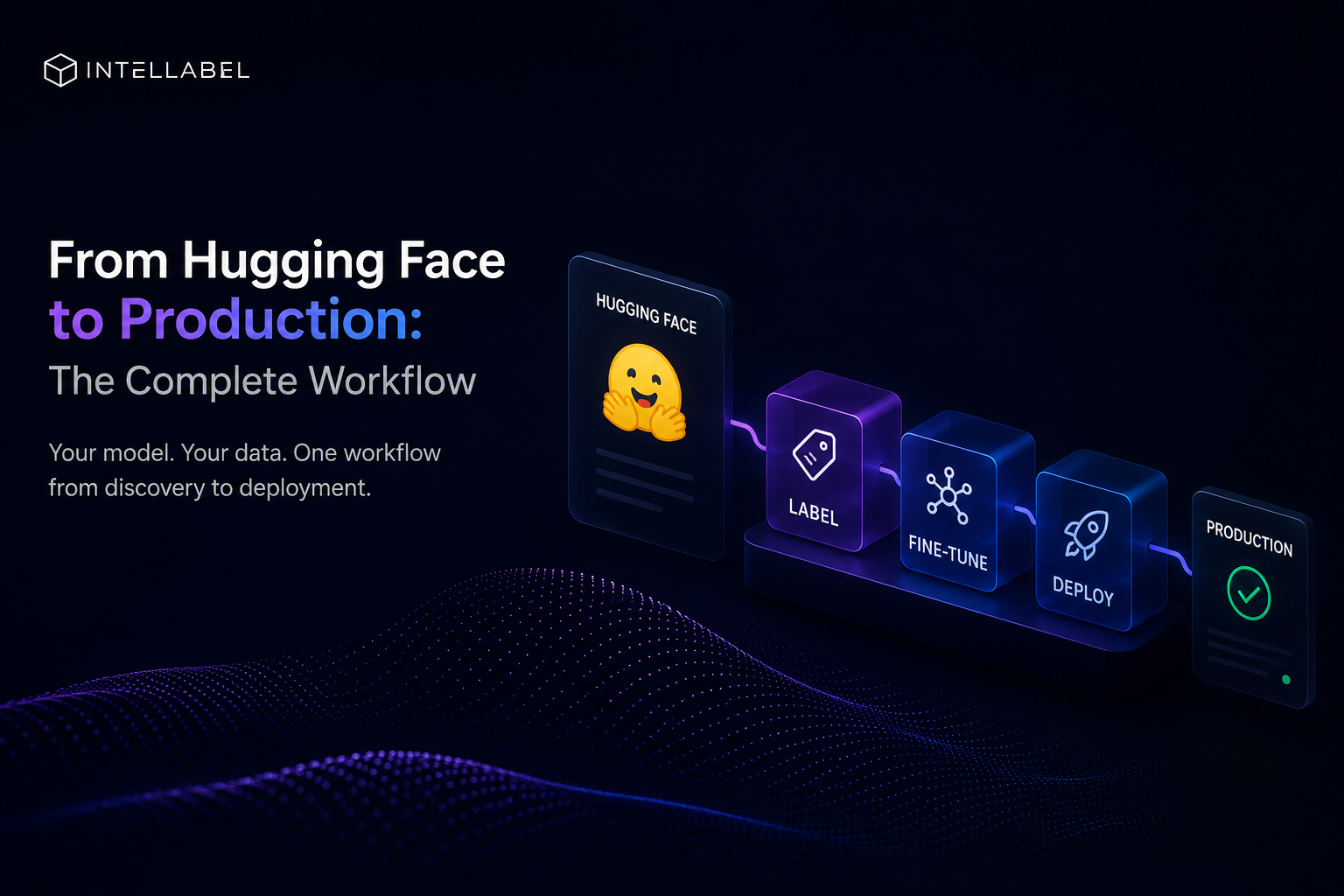
Intellabel was built specifically for this workflow. Import from Hugging Face directly into the platform, host for active learning, label what the model doesn't understand, fine-tune within the same workspace, deploy through managed pipelines, monitor via the same metadata that tracked the labeled samples. Six steps, one audit log. The integration is the value.
The 12-week timeline becomes 4 weeks
Teams operating this workflow on integrated tooling consistently ship a BYOM model in roughly 4 weeks. Teams stitching together 4-6 separate tools consistently take 12+. The model is the same. The platform layer determines the calendar.
From Labeling to Structured AI Data Pipelines


Address: WeWork, Salarpuria Symbiosis, Bannerghatta Rd, Bengaluru, Karnataka

.png)