
July 02, 2026
ISO 42001 for AI Management Systems: What Your Compliance Team Wants to Know
ISO 42001 — the AI Management System standard published in late 2023 — is the compliance frontier most companies haven't started preparing for. Enterprise procurement teams are already asking about it. By 2027, it will be a default ask alongside ISO 27001 and SOC 2.
What ISO 42001 actually is
A management system standard for AI, equivalent in scope and structure to ISO 27001 for information security or ISO 9001 for quality. It defines how an organization governs the AI it develops, procures, and deploys — not the AI itself, but the management around it.
Certification means an external auditor has verified that your AI governance practices meet the standard. The audit is annual.
Who's actually going to care
Enterprise customers in EU, financial services globally, healthcare in major markets, government adjacent organizations, and any customer that already requires ISO 27001 will start asking for ISO 42001 within 18 months. Smaller customers will follow within three years.
The pattern follows ISO 27001 adoption from 2014-2020 — first it's a nice-to-have differentiator, then it's table stakes.
What the standard requires
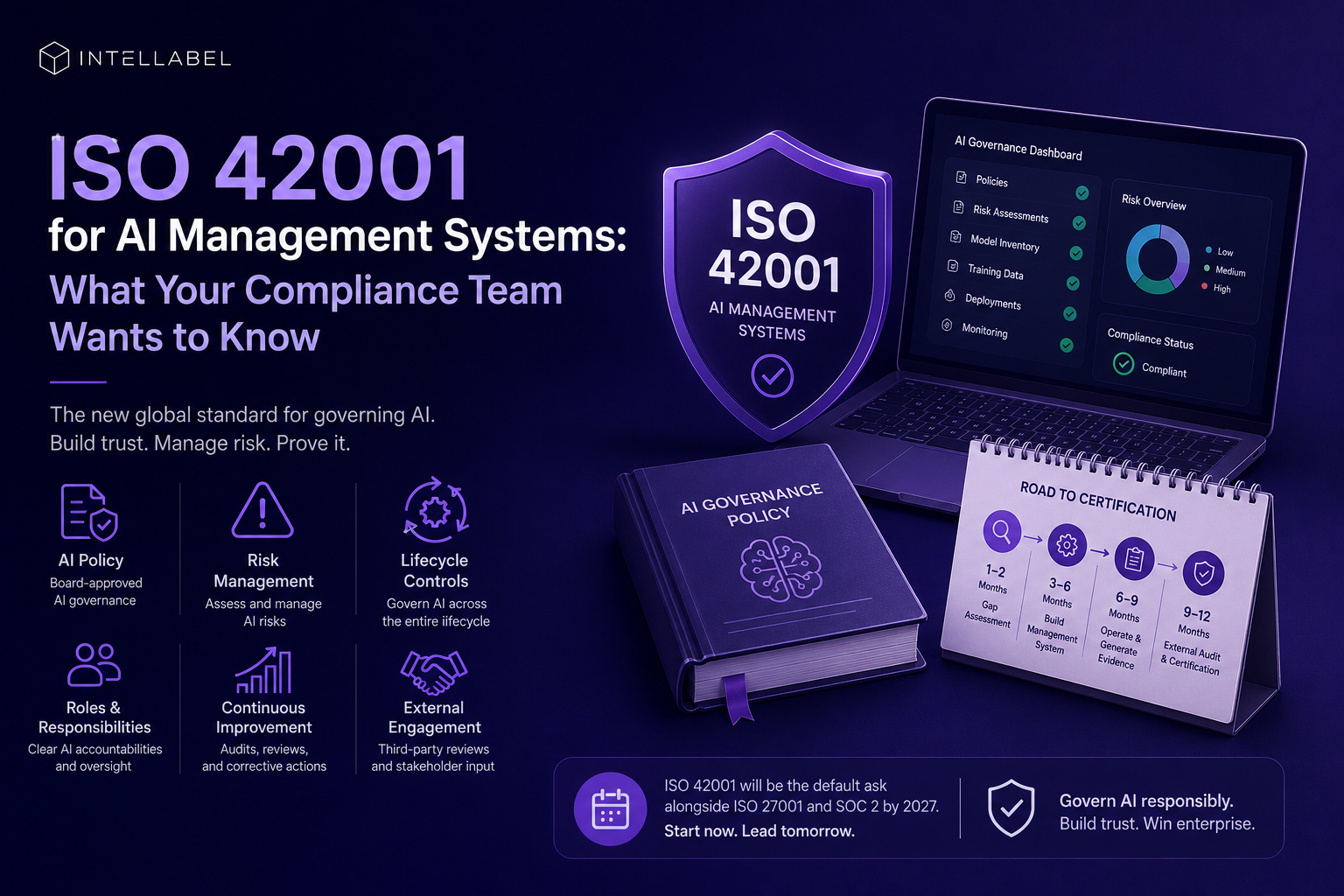
Six management system elements, each with concrete obligations. AI policy — board-approved policy on AI use and development. Risk management — process for assessing AI risk before deployment. Lifecycle controls — controls covering data, model development, deployment, monitoring, retirement. Roles and responsibilities — designated AI accountabilities (often an AI Officer or equivalent). Continuous improvement — internal audits, management reviews, corrective actions. External engagement — thirdparty reviews, stakeholder consultation where relevant.
What's actually hard
The standard is not technically hard. It's organizationally hard. Most companies don't have a documented AI policy. Most companies don't have a board-level AI accountability. Most companies haven't run an internal audit of their AI systems. These take time to build, and ISO 42001 wants evidence over time, not snapshots.
Start now if you'll need it in 2027
A realistic timeline to certification. Month 1-2: gap assessment against the standard. Month 3-6: build the management system — policy, processes, roles. Month 6-9: operate the system, generate evidence (audit logs, review minutes, risk assessments). Month 9-12: external audit and certification. Total: 12 months minimum.
If you need certification by January 2028, start the gap assessment by January 2027. Most companies underestimate by 6+ months.
Where platform tools help
Two of the six management system elements — lifecycle controls and continuous improvement — depend on having a comprehensive audit trail across data, models, and deployments. Companies whose AI development is fragmented across notebooks, separate annotation tools, and ad-hoc deployment scripts spend enormous time constructing the evidence ISO 42001 requires. Companies whose AI runs through an integrated platform inherit the evidence as a byproduct.
Intellabel's Enterprise tier maps audit log exports to ISO 42001 evidence requirements directly. This isn't marketing — it's that the data the standard wants (labeling provenance, dataset versions, training runs, deployment history) is the same data the platform persists by default.
The conversation to have
If you're in a role where you'd be the AI Officer if you had one, the question for your CEO and Board is simple: do we expect enterprise customers in 24 months to ask about AI governance certification? If yes, the work to be ready starts now.
From Labeling to Structured AI Data Pipelines


Address: WeWork, Salarpuria Symbiosis, Bannerghatta Rd, Bengaluru, Karnataka

.png)