
July 08, 2026
The Model Card: How to Generate One That Auditors Actually Accept
A model card is supposed to be a transparency artifact. In most engineering teams, it's an after-the-fact wiki page nobody updates. When an auditor asks for one — under EU AI Act, NIST AI RMF, ISO 42001, FDA, or any of the half-dozen regulatory frameworks now demanding them — the gap shows up fast.
Here's what a model card that passes audit looks like, and how to generate it automatically.
Five sections that satisfy most audits
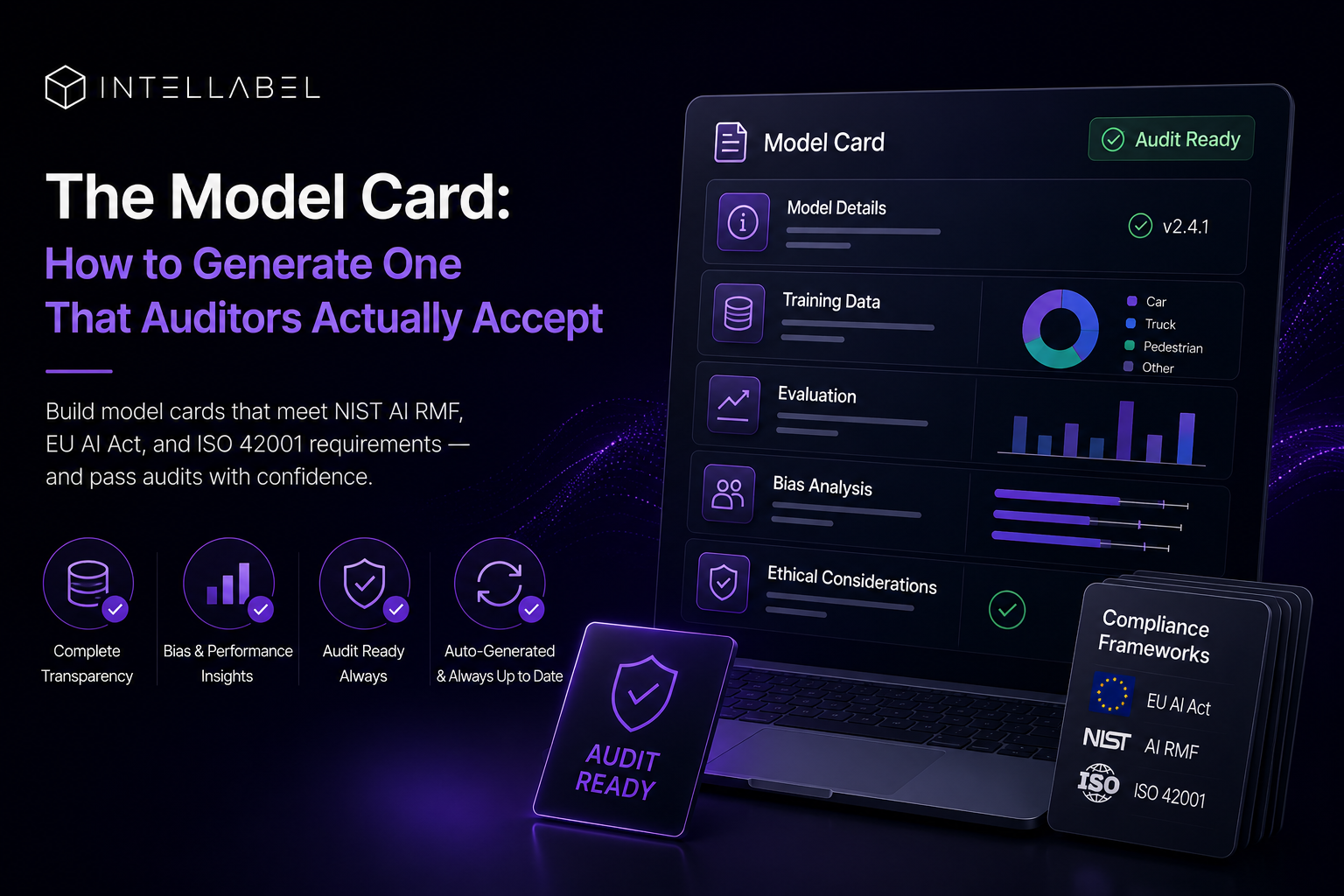
Model details: name, version, training date, owner, intended use, out-of-scope use, license. Most cards have this. Auditors check it but it's never the gap.
Training data: source, size, class distribution, labeling provenance, known biases or gaps, date range. Most cards say 'internal proprietary dataset' and stop. Auditors push back.
Evaluation: metrics (accuracy, precision, recall, F1, IoU), evaluation dataset, performance by relevant subgroups (demographic, geographic, condition), failure modes documented. The subgroup analysis is where most cards fail.
Quantitative analysis of biases: how the model performs across the subgroups, with confidence intervals. This is the section that did not exist in 2022 cards and is mandatory in 2026 cards.
Ethical considerations and limitations: documented risks, mitigations, known failure cases, the contexts in which the model should not be used. Auditors want to see thinking, not a checkbox.
The four most-missed sections
First, dataset version linkage — what specific labeled dataset version produced this model? Not just 'our training data' but the exact snapshot. Without this, you cannot reproduce the model.
Second, labeling provenance — who labeled the data, with what QA process, what inter-annotator agreement. Auditors will ask. 'External vendor' is not enough.
Third, subgroup performance — accuracy broken down by demographic, geographic, or scenario subgroup. Required under EU AI Act for high-risk systems.
Fourth, monitoring plan — how performance will be tracked in production. Required under NIST AI RMF as part of the 'Manage' function.
Static cards die fast
A model card written in Markdown and committed to a repo gets stale within a quarter. Subgroup performance changes as production traffic shifts. Drift metrics change weekly. Auditors checking a sixmonth-old card find it doesn't reflect current reality, and audit findings escalate.
The model card needs to be a live artifact, regenerated from the platform's metadata each time the model is retrained or evaluated.
Auto-generation is the only sustainable approach
If your platform tracks dataset versions, training runs, evaluation metrics, and production monitoring centrally, the model card is a query against that data, not a separate document. Auto-generation eliminates the staleness problem and makes audit response a 24-hour operation, not a six-week scramble.
Intellabel's MLOps and Enterprise tiers generate model cards automatically from training and monitoring metadata. The card is the export — when an auditor asks, you deliver. The work is in setting up the platform correctly once, not in writing cards quarterly.
Practical test
Open your most recently shipped model card. Does it specify the exact dataset version it was trained on? Does it document labeling provenance? Does it report subgroup metrics? Does it have a production monitoring plan? If the answer to any of these is no, the card will not survive a 2026-era audit. Fix the gaps before the audit, not during.
From Labeling to Structured AI Data Pipelines


Address: WeWork, Salarpuria Symbiosis, Bannerghatta Rd, Bengaluru, Karnataka

.png)