
June 17, 2026
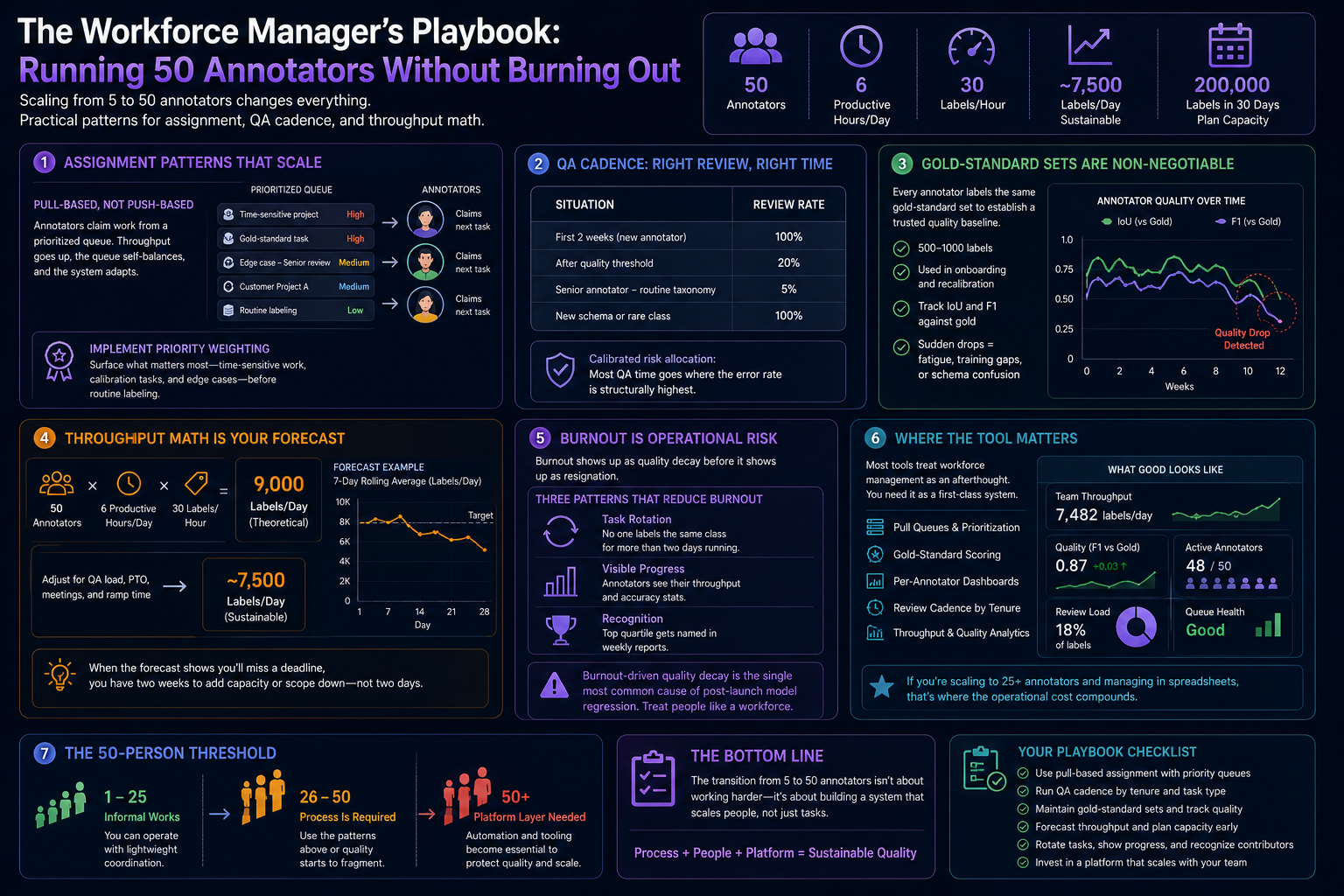
The Workforce Manager's Playbook: Running 50 Annotators Without Burning Out
Five annotators is a small team — you assign work in Slack, check accuracy by eye, and the workflow runs itself. Fifty annotators is an operation. The mistakes that don't matter at 5 become structural failures at 50. This is the playbook.
Assignment patterns that scale
Pull-based, not push-based. Annotators claim work from a prioritized queue rather than receiving assignments. Throughput goes up because faster annotators take more, slower ones take less, and the queue self-balances. Push assignment creates artificial bottlenecks when one annotator is sick or slow.
Implement priority weighting. Time-sensitive customer projects, gold-standard calibration tasks, and edge cases needing senior review should be tagged so they surface before routine work.
QA cadence: not every label, not too few
Reviewing 100% is expensive and creates a bottleneck. Reviewing 5% is too few to catch systematic errors. The pattern that works at 50-annotator scale: 100% review for the first 2 weeks of every annotator's tenure, 20% review after they hit a quality threshold, 5% review for senior annotators on routine taxonomies, 100% review on any new schema or rare class.
This is calibrated risk allocation. Most QA time goes where the error rate is structurally highest — new joiners and new tasks.
Gold-standard sets are non-negotiable
At 50 annotators, you cannot measure agreement by eye. You need a gold-standard set — 500-1000 labels you trust completely — that every annotator labels during onboarding and recalibration. Track each annotator's IoU and F1 against gold over time. Sudden drops indicate fatigue, training gaps, or schema confusion.
Throughput math is your forecast
At small scale, throughput is whatever it is. At 50-annotator scale, you forecast. Track labels per annotator per hour by task type. Plot a 7-day rolling average. When the forecast shows you'll miss a customer deadline, you have two weeks to add capacity or scope down, not two days.
A simple table: 50 annotators × 6 productive hours × 30 labels per hour = 9,000 labels per day. Adjust for QA load and PTO, you get roughly 7,500 labels per day sustainable. If a project needs 200,000 labels in 30 days, you need to add capacity or extend the timeline.
Burnout is operational risk
Annotation work is repetitive. Burnout is real and shows up as quality decay before it shows up as resignation. Three patterns that reduce burnout: task rotation (no one labels the same class for more than two days running), visible progress (annotators see their throughput and accuracy stats), and recognition (the top quartile gets named in weekly reports).
Burnout-driven quality decay is the single most common cause of post-launch model regression. Treating annotators as a workforce, not a function, isn't just ethics — it's operational.
Where the tool matters
Most annotation platforms ship workforce-management features as an afterthought. Intellabel's Workforce Manager treats annotator throughput, quality, and queue management as first-class objects — pull queues, gold-standard scoring, per-annotator dashboards, and review cadence by tenure are configurable rather than custom-built. If you're scaling to 25+ annotators and managing it in spreadsheets, that's where the operational cost compounds.
The 50-person threshold
Below 25 annotators, you can operate informally. Above 25, you need the patterns above or quality fragments. Above 50, you need the platform layer to handle them automatically. The transition is where most labeling operations fail quietly — not because the people are wrong but because the process didn't scale with them.
From Labeling to Structured AI Data Pipelines


Address: WeWork, Salarpuria Symbiosis, Bannerghatta Rd, Bengaluru, Karnataka

.png)