
June 24, 2026
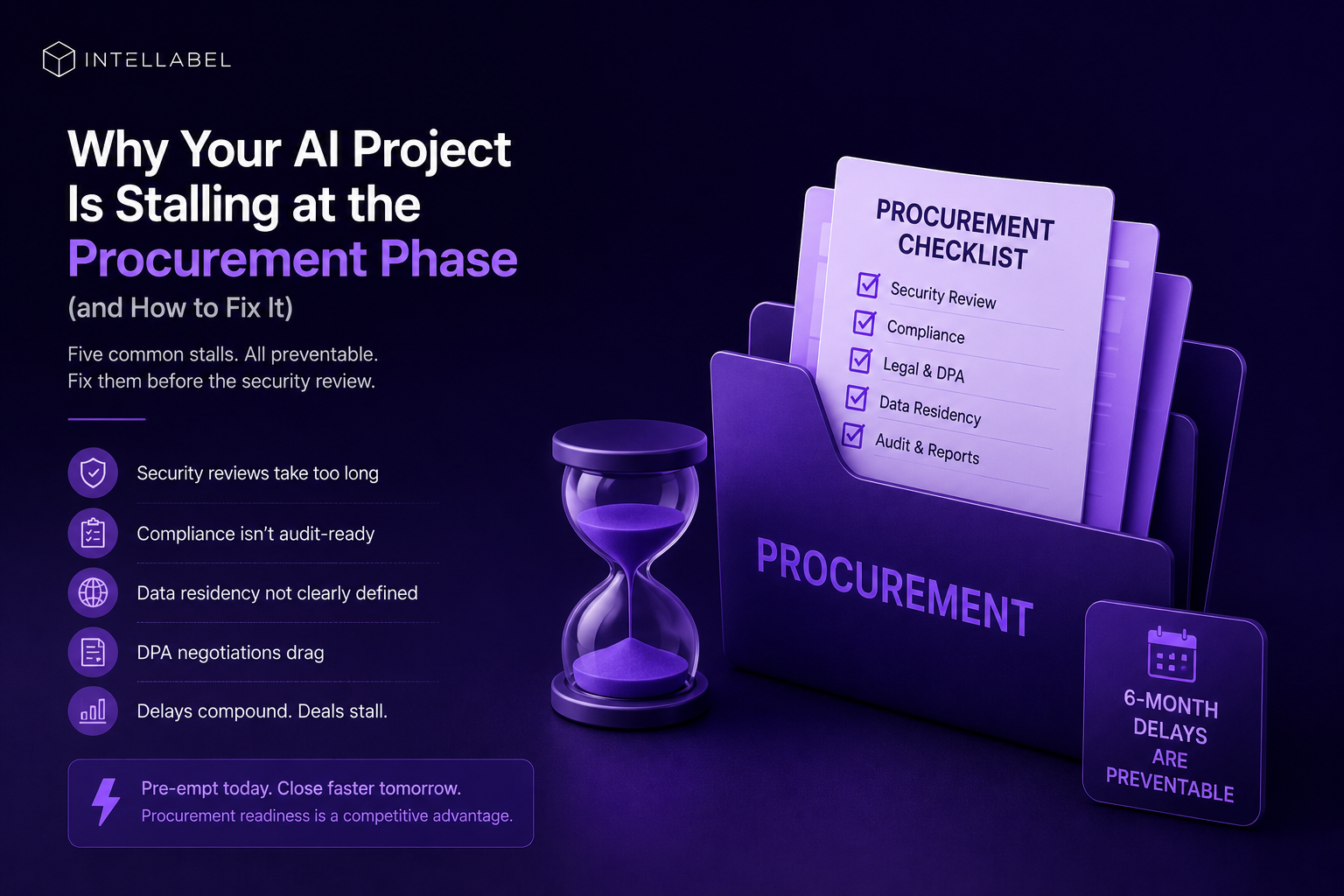
Why Your AI Project Is Stalling at the Procurement Phase (and How to Fix It)
Engineering shipped on time. The model works. The customer is excited. Then procurement opens the file. Three weeks become three months. Six weeks become six. The team that was going to move 'fast' didn't account for the time it takes to sell to a regulated enterprise.
Five stalls account for 80% of post-engineering delays. Each is preventable.
Stall 1: Security questionnaire takes a month per page
The vendor security questionnaire (VSQ) is usually 200-400 questions. If your security team answers them ad-hoc per deal, response time is measured in calendar weeks. The fix: maintain a single source of truth for all VSQ answers, updated quarterly. When a new questionnaire arrives, you're answering deltas, not the whole thing.
Stall 2: Penetration test report is 'in progress'
Customer procurement often requires a current penetration test report. 'We had one last year' isn't enough — most security teams want a report dated within the last 12 months. The fix: schedule annual penetration tests with a recurring vendor, publish executive summaries that NDA-protect specifics but provide the assurance customers need.
Stall 3: SOC 2 audit not in flight
Customers above $50M revenue typically require SOC 2 Type II. If your audit hasn't started, you're 8-12 months from being able to provide a report. The fix: begin SOC 2 the day you sign your first customer above $5M ARR. The audit cost ($25-80K depending on scope) is trivial against the deal velocity it unlocks.
Stall 4: Data residency questions
European customers ask where their data lives. Indian customers ask the same. Both expect a specific answer — 'EU customers' data stays in Frankfurt; Indian customers' data stays in Mumbai.' If your data residency story is 'AWS us-east-1', regulated customers will pause the deal. The fix: design multi-region from the start, even if you only need one region in year one.
Stall 5: Data Processing Agreement (DPA) negotiation
GDPR-regulated customers will send a DPA, often customized. If you negotiate every clause from scratch, expect 4-6 weeks per deal. The fix: publish a baseline DPA template on your website and pre-negotiate the most-redlined clauses with legal up front. When a customer-specific DPA arrives, you're triaging against a known starting position.
The compounding effect
Each stall is 2-4 weeks. They don't run in parallel — they compound, because the customer's procurement team is one person handling all of them sequentially. Five stalls in series is 10-20 weeks of delay between 'engineering done' and 'contract signed'.
Companies that pre-empt all five typically close deals in 3-6 weeks post-engineering. Companies that handle each ad-hoc consistently see 6-month delays
What to publish before your next sales cycle
A trust center page with: SOC 2 status (in progress or complete), ISO 27001 certificate, current penetration test executive summary, data residency options, DPA template, subprocessor list, security policies summary. Most of this exists already — putting it on a single discoverable page compresses every future procurement cycle by 60%.
Intellabel's pricing page surfaces ISO 27001 and SOC 2 status directly. The conformity exports — EU AI Act, NIST AI RMF, ISO 42001 — answer a class of customer questions before they get asked. The platform decision and the procurement decision are the same decision in 2026; the buyers who appreciate this win shorter sales cycles.
From Labeling to Structured AI Data Pipelines


Address: WeWork, Salarpuria Symbiosis, Bannerghatta Rd, Bengaluru, Karnataka

.png)