
May 18, 2026
Benchmarking AI-Assisted Labeling: Pre-labels, Active Learning, and When They Actually Save Time
Every data annotation platform in 2026 markets AI-assisted labeling. Pre-labels from foundation models. Active learning that picks the hardest examples for humans. Promises of 10× speedups and massive cost reductions.
The promises aren't wrong, exactly. They're conditional. AI-assisted labeling produces real, measurable productivity gains on some labeling tasks and quietly slows teams down on others. The difference between the two depends on dataset size, label complexity, quality bar, and how well the pre-labeling integrates into the human review workflow.
This post walks through actual benchmarks. Five labeling scenarios, each with timing and quality measurements from real workflows. We'll be specific about where AI-assist helps, where it hurts, and what that means for how you configure your own pipeline.
The Benchmark Setup
Before the numbers, a quick methodology note so you can judge them fairly.
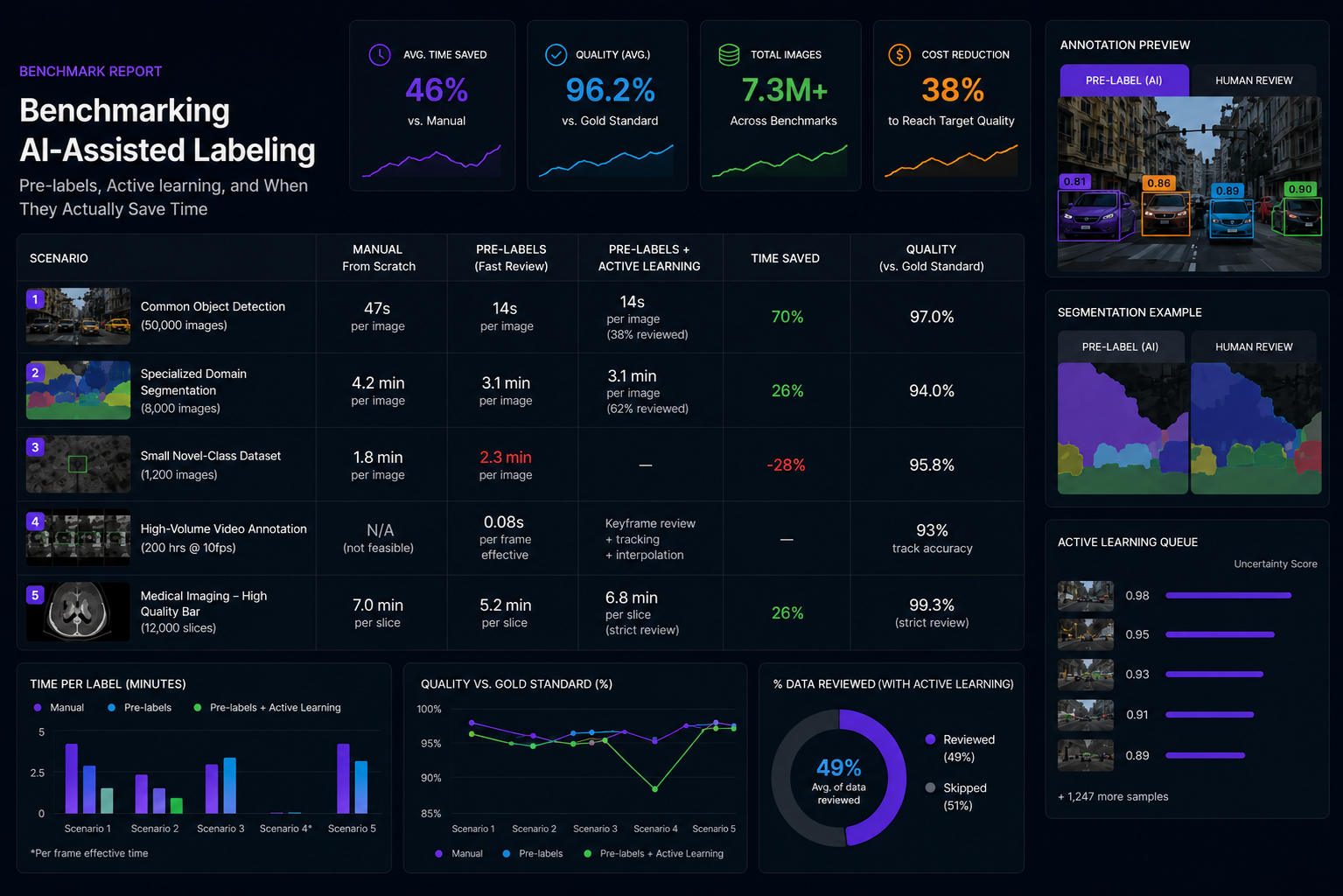
We measured five scenarios across real production workflows, using a mix of Intellabel's internal data and anonymized benchmarks from customer projects. For each scenario we compared: manual labeling from scratch, manual labeling with pre-labels generated from a foundation model, and manual labeling with pre-labels plus active learning selection of what to label next.
Metrics: time per label (minutes), final label quality (measured against a gold-standard ground truth set), and total cost to reach a target model accuracy.
Caveats: these numbers are illustrative of the patterns we see, not guarantees. Your results will vary based on your specific data, your annotators' skill, your review process, and how well your pre-labeling model fits your domain. Treat them as a calibration, not a promise.
Scenario 1 — Common Object Detection on Natural Images
Task: bounding boxes around common objects (people, vehicles, street furniture) in outdoor scenes. 50,000 images. Pre-labeling model: a general-purpose detector fine-tuned on similar data.
Manual from scratch: 47 seconds per image average. Quality: 97.2% agreement with gold standard after one round of review.
With pre-labels: 14 seconds per image average (a 70% time reduction). Quality: 97.1% agreement — statistically indistinguishable from manual.
With pre-labels plus active learning: 14 seconds per image on the labeled subset, but only 38% of the dataset needed full human review. Quality: 97.0% agreement across the full dataset.
Verdict: Strong win for AI-assist. This is the canonical 'pre-labeling works' scenario — common objects, plentiful training data for the pre-labeling model, relatively forgiving quality bar.
Scenario 2 — Specialized Domain Segmentation
Task: pixel-perfect segmentation of specific defect types on manufacturing line imagery. 8,000 images. Pre-labeling model: a SAM-2 variant with domain-specific prompting.
Manual from scratch: 4.2 minutes per image. Quality: 94.8% pixel-level agreement.
With pre-labels: 3.1 minutes per image (26% time reduction). Quality: 94.2% agreement — slightly lower, because reviewers occasionally accepted pre-label boundaries that were close but not precisely correct.
With pre-labels plus active learning: 3.1 minutes per image on the subset reviewed, with 62% of the dataset fully reviewed. Quality: 94.0% across the full dataset.
Verdict: Moderate win. The pre-labeling model was good enough to speed work up, but not accurate enough to make the speedup dramatic. Active learning helps more by reducing how much needs to be done than by making each task faster.
Key insight: for specialized segmentation, the quality of the pre-labeling model matters enormously. A mediocre pre-labeling model causes reviewers to redraw more than they accept, which provides almost no speedup — and sometimes actively slows things down because switching between 'evaluate' and 'redraw' has overhead.
Scenario 3 — Small Novel-Class Dataset
Task: labeling a new defect class that didn't exist in any training data, on 1,200 images. No pre-trained model could do this well.
Manual from scratch: 1.8 minutes per image. Quality: 96.1% agreement.
With pre-labels (using a zero-shot foundation model): 2.3 minutes per image — slower. The pre-labels were usually wrong, and reviewers had to spend time deleting them before labeling from scratch. Quality: 95.8%.
Active learning: n/a — no model to inform selection on a novel class with this little data.
Verdict: AI-assist hurts. This is the scenario that marketing material ignores. For small datasets with novel classes, pre-labeling is pure overhead. The right move is to label manually, use that data to train a domain-specific pre-labeling model, and then use the pre-labels on subsequent batches.
Rule of thumb: below about 3,000 labels for a truly novel class, pre-labeling is usually negative ROI.
Scenario 4 — High-Volume Video Annotation
Task: tracking-through-frames annotation of objects on 200 hours of video at 10fps (7.2M frames). Pre-labeling: per-frame detection plus track association.
Manual frame-by-frame: impossible at this scale, pragmatically — we didn't benchmark it.
With pre-labels plus track association plus interpolation: 0.08 seconds per frame effective, with humans reviewing keyframes and correcting track boundaries. Quality: 93% track accuracy, which is near the ceiling of what's achievable even with ideal labeling.
Verdict: Enormous win — but the win comes almost entirely from interpolation and tracking automation, not from per-frame pre-labeling quality. Video is where AI-assist is most valuable, because the alternative is genuinely not feasible at scale.
Scenario 5 — Medical Imaging with High Quality Bar
Task: segmentation of anatomical structures on CT slices. 12,000 slices. Quality bar: radiologist-acceptable, i.e., zero tolerance for errors in diagnostically-relevant regions.
Manual: 7 minutes per slice. Quality: 99.3% agreement after two-stage review.
With pre-labels (domain-tuned model): 5.2 minutes per slice. Quality: 98.8% — slightly lower, because subtle errors in pre-labels slipped past reviewers more often than they would have with pure manual work.
With stricter review protocol that forces reviewers to re-verify pre-label boundaries against the image rather than just accept them: 6.8 minutes per slice. Quality: 99.4% — essentially the same as manual.
Verdict: Marginal. In the highest quality bar scenarios, pre-labels save time only if you accept slightly lower quality, or cost time if you maintain the same quality bar through stricter review. The savings are real but small, and whether they're worth it depends on whether the tiny quality delta is acceptable for your use case.
What the Patterns Tell Us
Five scenarios, five different answers. But the patterns across them are consistent.
Pre-labeling quality determines everything. A pre-labeling model that's roughly as good as a trained annotator provides big speedups. A pre-labeling model that's noticeably worse provides small or negative speedups, because humans spend more time fixing than labeling saves.
Dataset size matters more than people admit. Pre-labeling has fixed overhead — model setup, inference infrastructure, integration. Below about 5,000 labels, that overhead often exceeds the savings. Above 50,000, it's usually worth it. In between, it depends on the task.
Quality bar is the quiet variable. For tasks where 95% quality is fine, AI-assist is nearly always a win. For tasks where 99.5% quality is required, AI-assist can increase throughput only if you invest in stricter review to catch the pre-label errors that slip past faster reviewers.
Active learning compounds, but only after you have a working model. Active learning needs predictions to rank examples by difficulty. On a cold-start dataset, it can't help. Its value kicks in on your second, third, and fourth rounds of labeling — when each round can prioritize what will help the model most.
A Decision Framework
Based on the scenarios above, here's a simple framework for deciding whether to use AI-assisted labeling for a given task.
Use pre-labels when: your dataset is larger than 5,000 labels, a pre-labeling model exists that's within 10% accuracy of your human baseline, and your quality bar is around 95% agreement or looser.
Use pre-labels plus stricter review when: your quality bar is 98%+, but your volume justifies the integration overhead (20,000+ labels).
Use active learning when: you're in your second or later labeling round, you have a working model, and you want to prioritize the most impactful examples for the next round.
Skip AI-assist when: your dataset is small and your classes are novel, your pre-labeling model is noticeably worse than your annotators, or your integration overhead would exceed the realistic savings.
The tragedy of 'AI-assist' marketing is that it sells it as universal. The reality is that it's a powerful tool with a specific envelope of utility. Teams that match the tool to the task save real money. Teams that apply it indiscriminately lose it.
How Intellabel Thinks About This
We built Intellabel's AI-assist features to be configurable rather than assumed. You can run projects in any of four modes:
Manual first, pre-labels later — you label the initial batch by hand, train a pre-labeling model on it, and switch on pre-labels for subsequent batches.
Pre-labels with fast review — reviewers accept or reject pre-labels with minimal drawing, for high-throughput scenarios.
Pre-labels with strict review — reviewers verify boundaries pixel-by-pixel against the source image, for high quality bars.
Active learning loop — the platform automatically ranks unlabeled examples by model uncertainty and queues them for review first.
This is deliberate. The tools should match the job, not the other way around. If you want to see how we configure active learning and pre-labeling for your specific task and quality bar, book a technical walkthrough — we'll run the benchmarks on your data alongside you.
From Labeling to Structured AI Data Pipelines


Address: WeWork, Salarpuria Symbiosis, Bannerghatta Rd, Bengaluru, Karnataka

.png)