
April 30, 2026
Labelbox vs Encord vs CVAT vs Intellabel: A Data Ops Platform Comparison (2026)
Full disclosure upfront: this post is written by Intellabel. We'll tell you where we think we win, where we don't, and what each of the other three platforms genuinely does better. If a comparison article spends 3000 words saying its own product is the best at everything, stop reading it — no platform is.
The goal here is to help you shortlist intelligently. By the end of this post, you should know exactly which two of the four you should actually evaluate, and what questions to ask in the demo.
Here's how we'll break this down: first, the five dimensions that actually matter for computer vision teams. Then each platform's honest profile across those dimensions. Then a decision tree for matching platform to team. No fluff.
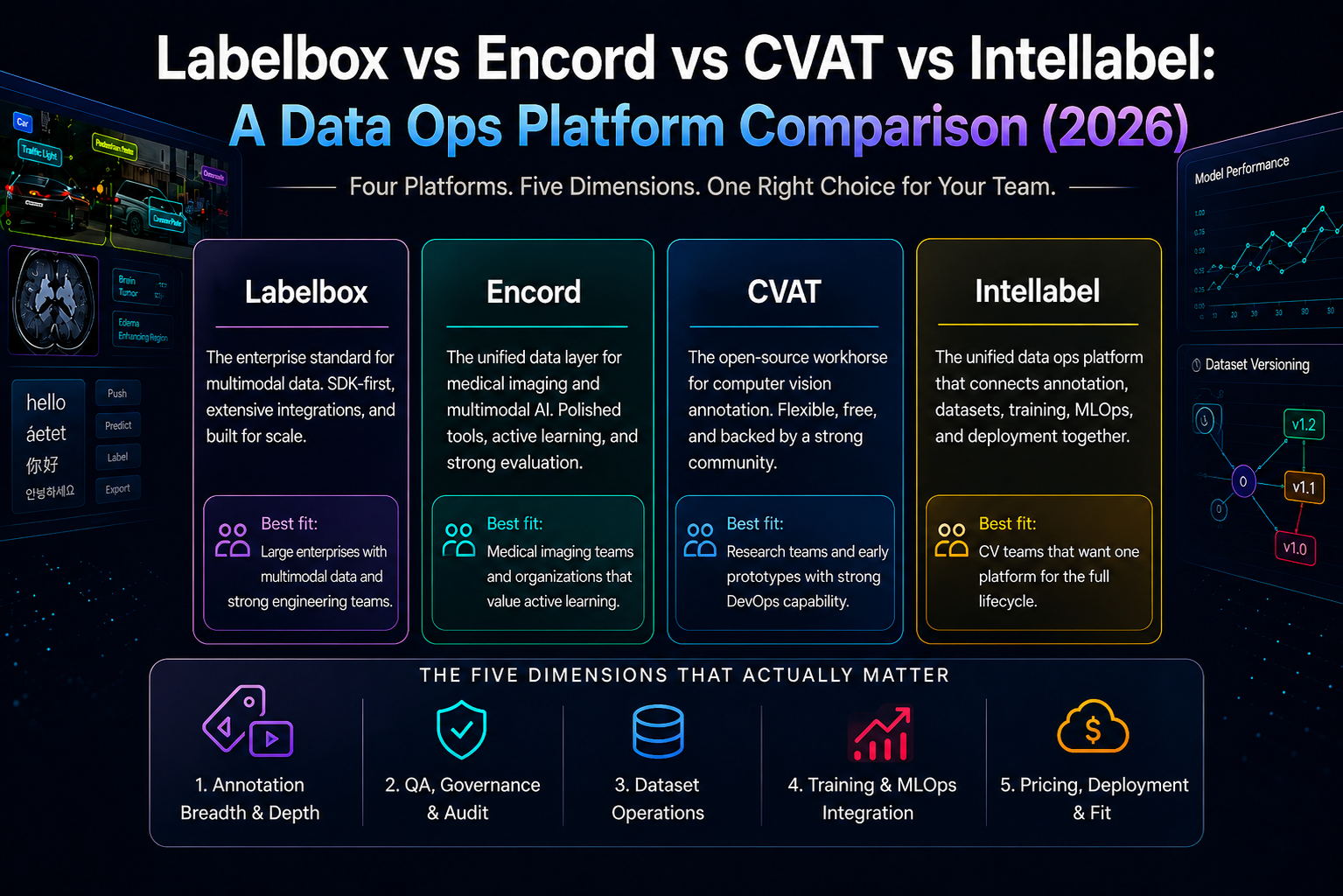
The Five Dimensions That Actually Matter
Most comparison articles compare features the vendors brag about. That's the wrong lens. What actually matters when you're going to live with a tool for the next three years:
- Annotation breadth and depth. How many label types, how much video, 3D, and specialized formats, how good is the pre-labeling.
- QA, governance, and audit. Multi-stage review, audit trails, role-based access, enterprise compliance — these matter more as your team grows and as regulators pay attention.
- Dataset operations. Versioning, lineage, splits, filtering, curation of hard examples.
- Training and MLOps integration. Does the platform stop at the label export, or does it carry through to training runs, model registry, and deployment?
- Pricing, deployment, and fit. Total cost at your volume, cloud vs. on-prem, vendor lock-in risk.
Labelbox
Labelbox is the category's mature enterprise standard. It has been around long enough to be trusted by Fortune 500 ML teams, it supports multimodal data (image, video, text, geospatial, documents), and its API and SDK are among the best in the industry.
Where Labelbox wins: multimodal coverage, SDK-first architecture that engineering teams love, extensive integrations with AWS, GCP, Azure, and Databricks, and enterprise-grade security posture (SOC 2, HIPAA, GDPR). If your team is already deep in a major cloud ecosystem and you have engineering capacity to build around an API, Labelbox is a natural fit.
Where Labelbox struggles: pricing scales aggressively with volume, and teams regularly report sticker shock at the 1M+ label mark. MLOps integration is lighter than you'd expect — Labelbox owns annotation and some dataset ops, but training and model lifecycle still live elsewhere. You're still stitching tools. And for pure computer vision teams without the multimodal requirement, you're paying for breadth you don't need.
Best fit: large enterprise teams with multimodal data, strong engineering resources, and existing cloud ecosystem commitments.
From Labeling to Structured AI Data Pipelines
Encord
Encord has built a strong position as a unified data layer for AI teams, particularly in medical imaging and multimodal applications. Their annotation tooling is polished, their DICOM and NIfTI support is best-in-class, and their active learning and evaluation loops are genuinely well-designed.
Where Encord wins: medical imaging workflows, multimodal data (video, audio, document, text alongside image), active learning that's integrated rather than bolted on, and strong model evaluation features. If you're building a medical AI product or need deep multimodal support, Encord deserves a serious look.
Where Encord struggles: MLOps is still not their native territory. Training runs, model registry, deployment pipelines, and production monitoring typically happen outside Encord. You're still assembling pieces. The learning curve is also steeper than most teams expect — Encord is powerful, but it rewards time invested in learning it.
Best fit: medical imaging teams, multimodal AI teams, and organizations that value active learning as a core workflow rather than an afterthought.
CVAT
CVAT is the open-source workhorse of computer vision annotation. It's free, it's flexible, it has a huge community, and it gets real work done. Most CV teams have used it at some point in their history.
Where CVAT wins: zero licensing cost, full source code access, self-hosting for data that can't leave your infrastructure, and a format ecosystem (COCO, YOLO, Pascal VOC exports) that makes it a safe starting point. For research projects, early prototypes, and teams with strong engineering that want maximum control, CVAT is a legitimate choice.
Where CVAT struggles: you are the ops team. Uptime, scaling, QA policy, governance, audit trails, and integration with training pipelines are all your problem. Past roughly ten thousand frames, CVAT starts to feel single-user even with cloud deployment — review queues, parallel collaboration, and performance tracking need to be built around it. There's no native model registry, no experiment tracking, and no production monitoring. Enterprise compliance (SOC 2, HIPAA) requires you to build and certify the surrounding infrastructure yourself.
Best fit: research teams, individual ML engineers, early prototypes, and organizations with strong DevOps capacity that prioritize control over convenience.
Intellabel
Intellabel is built on a different premise than the other three: that computer vision teams are tired of stitching annotation, dataset, training, and MLOps tools together, and that a genuinely unified platform can ship models more reliably than any best-of-breed combination.
Where Intellabel wins: end-to-end workflow from raw image to production model in a single platform. Annotation with AI-assisted pre-labels and active learning, dataset versioning with full lineage, multi-stage QA with audit trails, training pipelines with experiment tracking, model registry with promotion controls, and deployment with drift monitoring — all connected. No integration seams. Enterprise-grade security (SSO, RBAC, encryption, ISO-aligned controls). Transparent pricing that doesn't scale punitively with volume.
Where Intellabel is honest about gaps: we're CV-focused. If you need text, audio, or LLM workflows, we're not the right choice — Labelbox or Encord will serve you better. Our ecosystem is younger than Labelbox's, so some third-party integrations require custom work. And while we support DICOM and medical imaging workflows, Encord has more years of refinement there specifically.
Best fit: computer vision teams that want one platform for the full lifecycle, that have outgrown CVAT or a stitched stack, and that value operational consolidation over maximum modality breadth.
Side-by-Side Feature Comparison
The table below compares the four platforms on the dimensions we introduced at the start. Use it to calibrate your expectations — then verify in an actual demo.


The Decision Tree: Which One Should You Actually Pick?
If your data includes significant text, audio, or LLM components alongside vision: Labelbox or Encord. Intellabel and CVAT aren't built for this.
If you're in medical imaging with heavy DICOM/NIfTI requirements: Encord first, Intellabel second. Encord has the most years in this specific niche.
If you're a research team or early prototype with a small budget: start with CVAT. You can migrate later — most platforms support CVAT imports.
If you're a computer vision team that's hit the wall with CVAT or is tired of stitching Labelbox + W&B + SageMaker + scripts: this is Intellabel's sweet spot. You get the full data-to-model loop in one place, without sacrificing the QA and governance enterprise buyers need. If you're an enterprise with multi-year cloud commitments, heavy engineering resources, and multimodal needs:
Labelbox will feel most natural and integrate most cleanly with your existing stack.
One more honest note: most teams end up on a shortlist of two. Do a real pilot with both — annotate 1,000 real images, run one training cycle end-to-end, and measure time-to-model. Features matter less than how the platform behaves under actual work.
What to Ask in Any Demo
Regardless of which platforms you shortlist, here are the questions that actually separate the contenders from the pretenders:
Show me the lineage graph. Ask them to click from a production prediction back to the dataset, the labels, the reviewer, and the training run that produced it. If they can't, the governance story isn't real.
Show me what happens when I retrain with new labels. How much manual work does it take to go from 'we got 500 new labels' to 'a new candidate model is in the registry'?
Show me the QA reviewer interface and the audit log. Multi-stage QA is one of the biggest differentiators, and it's usually demoed poorly. Ask specifically.
Show me your pricing at my volume. Get a concrete number for your actual use case. If the answer is vague, that's the answer.
Show me a customer with my use case. Not a logo slide — an actual reference call you can take.
If you want to see Intellabel's answers to all five of those questions on your actual data, book a walkthrough with our team. We'll run the demo on your use case, not ours.


Address: WeWork, Salarpuria Symbiosis, Bannerghatta Rd, Bengaluru, Karnataka

.png)