
May 06, 2026
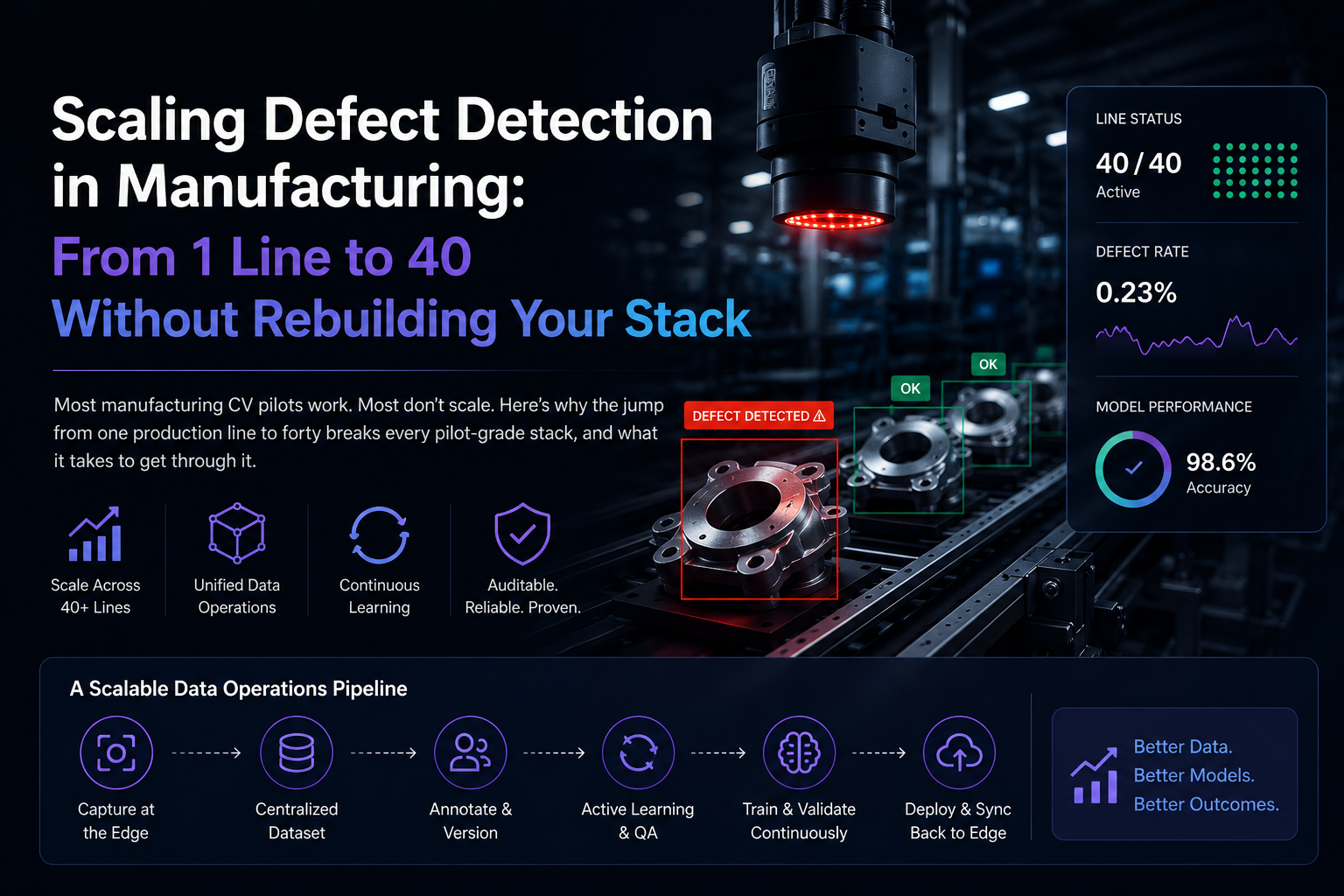
Scaling Defect Detection in Manufacturing: From 1 Line to 40 Without Rebuilding Your Stack
Walk into any Fortune 1000 manufacturer's AI roadmap presentation in 2026 and you'll see the same slide: a successful defect detection pilot on one production line, with a heroic accuracy number and a deck that says 'next step: enterprise rollout.'
Most of those rollouts stall. Not because the pilot was wrong. The pilot was right. The scaling effort is what's brutal — and the reasons are almost never what the pilot team predicts.
If you're a Head of AI or a manufacturing operations leader staring down that scaling cliff, this post is for you. We'll walk through the four walls that break most pilots between line 1 and line 40, and what a scalable data operations pipeline has to do differently.
Why Manufacturing CV Is Different
Before the walls, a quick frame on why this vertical is genuinely harder than the academic CV benchmarks suggest.
Manufacturing lines change. Not in the sense that academic datasets change (they don't). In the sense that a supplier substitutes a raw material, a die gets refurbished, a shift rotates, a new SKU launches on the line — and suddenly the visual appearance of 'normal' and 'defective' has shifted in ways your pilot never saw.
Manufacturing edge cases are rare but costly. Miss one in ten thousand defects on a cosmetics line and you've annoyed a customer. Miss one in ten thousand on a pharmaceutical line and you've got a recall. The acceptable error rate varies by orders of magnitude across industries, and your data operations need to account for that.
Manufacturing cameras are not cloud-first. Your model lives at the edge — on a factory floor server, often air-gapped from the corporate network, often running on modest hardware, often monitored by people who are not ML engineers. Your pipeline has to handle this reality.
These realities are why the playbook from a well-run pilot doesn't map cleanly to a well-run rollout.
Wall 1 — Line-to-Line Variance
Your pilot worked on Line 3 in the Toledo plant. You copy the model to Line 7 in the Dresden plant, and accuracy drops from 94% to 78%. What happened?
Everything in the image that isn't the defect is slightly different. Lighting color temperature, camera angle (even a two-degree shift changes things), background texture from a different conveyor belt, product orientation because Dresden's line runs the opposite direction. Your pilot model learned all of these as correlated features — it thought 'defect-like' included 'Toledo lighting.'
The fix is not 'train one model per line,' which is what most teams default to. That approach creates forty models to maintain, forty retraining loops to manage, and forty places for silent drift.
The fix is a data operations pipeline that can ingest data from all forty lines into a single dataset, properly labeled with line metadata, and train a model that's robust to the between-line variance while still performing well on any specific line. Your annotation platform has to support ingesting from many sources. Your dataset layer has to track line provenance. Your training has to support per-line evaluation so you can see when one line is underperforming the aggregate.
The simple version: Line 3's data needs to be a first-class member of your production dataset alongside every other line's data, from day one of planning, not retrofitted at rollout.
Wall 2 — Taxonomy Drift
In a pilot, you have one annotator, maybe two, labeling one line's data. Your taxonomy — your definition of 'scratch,' 'dent,' 'surface contamination,' 'color mismatch' — stays coherent because it lives in one person's head.
At forty lines, you have fifteen annotators in two countries over three years. Your 'scratch' class has three different interpretations. Your 'surface contamination' has been quietly split by one reviewer into 'dust' and 'oil' because they thought it was obvious. Your taxonomy document is dated March 2024 and nobody has looked at it since.
The model trained on this data learns a blurry average of fifteen overlapping interpretations. Production accuracy decays. Nobody can tell you why.
The fix is taxonomy versioning that's enforced at the platform level, not a PDF in Confluence. Every label records which schema version it was created under. Schema changes are events, not updates — they create migration tasks that flag affected labels for re-review. New annotators are onboarded against the current schema, with their first hundred labels audited for drift. Inter-annotator agreement is measured continuously, not as a one-off QA exercise.
This is what we mean by 'data operations.' The manufacturing floor has had SPC — statistical process control — for fifty years. Your labeling pipeline needs the equivalent.
Wall 3 — The Edge-to-Cloud Feedback Loop
Your model is running on the factory floor. It predicts a defect on a unit. A human inspector reviews. Sometimes the inspector agrees; sometimes they override.
Those overrides are the most valuable signal in your entire system. They are literally labeled ground truth, generated free, by the humans who know the line best. And in most deployments, they're thrown away.
Why? Because the path from 'inspector override on Line 7' back to 'new training data in the central dataset' typically involves: an ERP system, a CSV export, a weekly email, a manual review, a spreadsheet reconciliation, and maybe a batch ingestion job some engineer runs monthly. By the time the data gets back, it's stale, context is lost, and nobody trusts it.
A scalable manufacturing CV pipeline treats inspector overrides as first-class data events. They flow directly into a human-in-the-loop queue, get confirmed or rejected by a QA reviewer, and update the dataset within hours, not weeks. The next retraining run has them.
This loop is what separates a defect detection deployment that improves over time from one that degrades over time. Which kind of deployment is yours?
Wall 4 — Retraining Velocity
At one line, you can afford to retrain your model quarterly and do it manually. Spin up a training run, eyeball the metrics, ship it.
At forty lines, quarterly retraining means every line is running a model between 0 and 90 days stale, with no ability to respond quickly when something changes. If a supplier changes a material and your model suddenly starts missing a new type of defect, you need to get fresh training data, retrain, validate, and deploy within days — not months.
Manual retraining can't sustain this cadence. You need a retraining pipeline that triggers from the data layer: new labels arrive, dataset version increments, a training run auto-triggers, experiment tracking logs results, the model registry promotes candidates that beat the incumbent on holdout sets, staged rollouts push new models to a subset of lines for shadow inference, and after validation, the new model goes to full production.
The engineering burden of building this yourself, for manufacturing, is enormous. We know because we've watched good teams try and burn out. This is what a unified data operations platform is for.
What the Cost Curve Actually Looks Like
A brief note on economics, because the CFO conversation matters.
At one line, labeling costs maybe $30,000 for the initial model, plus $5,000/quarter for retraining data. Tolerable. At forty lines with full coverage and ongoing retraining, naive labeling costs scale linearly — so you're looking at $1.2M initial and $200,000/quarter in retraining data.
Active learning changes this curve dramatically, but only if it's integrated into your data operations pipeline. The premise is simple: your model identifies which examples it's least confident about, those go to human reviewers first, confident predictions get spot-checked rather than fully re-reviewed. In practice we see 50-70% reductions in labeling cost at scale — but it requires your annotation platform, dataset layer, and training loop to be speaking to each other.
This is the secondary reason platform consolidation matters for manufacturing AI: the savings from active learning alone typically pay for a unified platform several times over at the forty-line scale.
Eight Questions to Ask Any Platform Vendor
If you're a manufacturing AI leader evaluating vendors for the scaling phase, here's the shortlist of questions that actually separate the real solutions from the demo ware.
- How do you handle data from forty heterogeneous lines in a single dataset without requiring one model per line?
- Can I version my label taxonomy and see every label's schema provenance? Show me.
- How does an inspector override on the factory floor get into the training dataset, and how long does that take end to end?
- What's your active learning workflow? Show it running on a real dataset, not in a slide.
- How do I trigger a retraining run from a data event, automatically?
- Can my model registry support staged rollouts where a new model runs shadow inference on some lines before full deployment?
- What happens when one of my lines loses network connectivity? Do labeled data and override feedback queue locally and sync when it's back?
- At forty lines, what will this actually cost me next year — show me the math with my volume, not your standard slide.
The Bigger Picture
Manufacturing is arguably the highest-value computer vision application that exists today. The ROI of defect detection at scale is measurable in dollars saved per shift. The technology works. The algorithms are solved.
What's not solved, industry-wide, is the operational layer — the data operations fabric that turns a brilliant pilot into a fleet deployment that gets better every quarter instead of worse. Every manufacturer we talk to at the forty-line scale is wrestling with some version of the four walls in this post.
Intellabel was built, in large part, because we watched this scaling cliff eat too many good projects. If you're facing it, we'd like to show you what we've learned. Book a demo tailored to manufacturing teams — we'll walk through the full rollout pipeline on your scenario, including your specific line count, defect categories, and edge deployment requirements.
From Labeling to Structured AI Data Pipelines


Address: WeWork, Salarpuria Symbiosis, Bannerghatta Rd, Bengaluru, Karnataka

.png)