
May 27, 2026
Why Computer Vision Models Still Fail in Production (And It's Not Your Model)
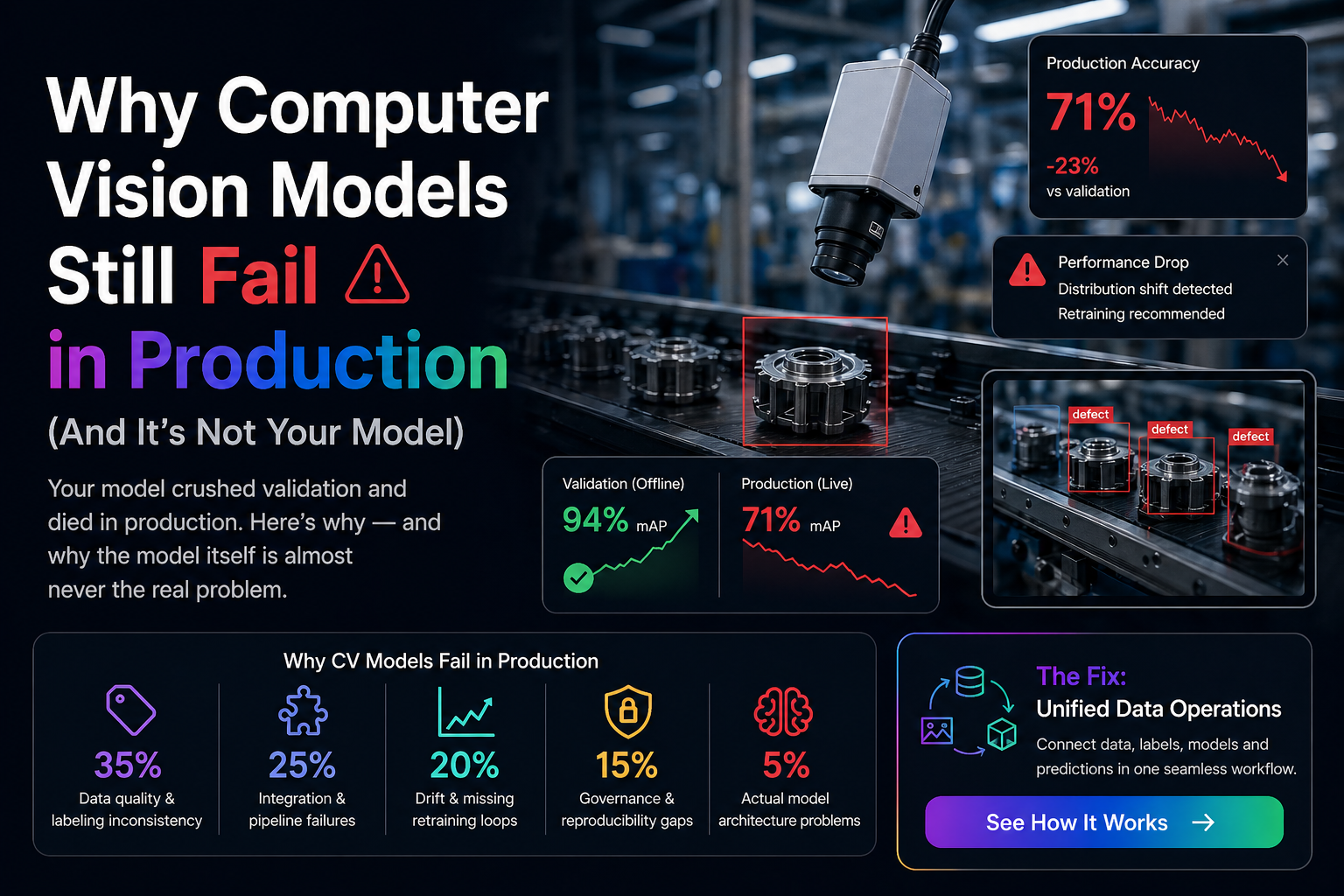
Your model hit 94% mAP on the validation set. Your team celebrated. Six weeks later, production accuracy is at 71% and the ops team is asking pointed questions.
If you've lived this, you're not alone. The industry has been quoting the same uncomfortable statistic for years: roughly 85–90% of machine learning models never make it to production. For computer vision teams, the number is arguably worse — because CV deployments face a harsher reality than most ML categories. Lighting changes. Cameras get dirty. Products get redesigned. A new SKU appears. A forklift knocks a sensor two degrees off axis. And suddenly your beautifully trained model is hallucinating.
Here's the thing almost nobody in this conversation will say out loud: the model is rarely the problem. After working with computer vision teams across manufacturing, retail, healthcare, agriculture, and logistics, a clear pattern emerges. When a production CV system fails, the model architecture itself is the cause in maybe 5% of cases. The other 95% of failures trace back to something in the data operations layer — and most teams don't even realize they have one.
It's Not the Model. It's the Data Operations.
Let's put real percentages on where CV production failures actually come from:
Data quality and labeling inconsistency — 35%. The single biggest failure category. Two annotators labeling the same defect differently. A taxonomy that drifted over six months without anyone updating the guidelines. Edge cases that got labeled one way in January and another way in June.
Integration and pipeline failures — 25%. The data flow breaks between tools. Labels don't round-trip cleanly from your annotation platform to your training code. A preprocessing step runs in one environment and not another. The production feature pipeline is subtly different from the training one. Drift and missing retraining loops — 20%. The production world has changed and your model hasn't. There's no system to detect it, no process to retrain, and no infrastructure to ship a new version safely.
Governance and reproducibility gaps — 15%. You can't figure out which dataset version trained the model that's live. You can't reproduce the training run that worked best. You can't audit why a specific prediction was made three weeks ago when a customer complained.
Actual model architecture problems — 5%. Yes, sometimes your architecture is wrong. Rarely the main problem.
The Stitched Stack Problem
Ask ten ML teams how their CV pipeline is built, and you'll hear variations on the same theme: a different tool for every stage.
Labels get created in Labelbox or CVAT. Raw images live in S3. Dataset versioning is managed through DVC or a custom Postgres table. Training runs in SageMaker or a home-grown Kubernetes cluster. Experiment tracking lives in Weights & Biases. Model registry is maybe MLflow, maybe a Confluence page. Deployment happens through some combination of Docker images, Lambda functions, and prayer.
Each tool, individually, is fine. Some are excellent. But every seam between two tools is a place where data can silently corrupt, where metadata gets lost, and where the thread of reproducibility snaps.
A concrete example: a manufacturing client we spoke to had their annotation workflow in CVAT, their dataset storage in S3, and their training pipeline on a custom script. When a model went sideways in production, they couldn't tell which version of the label taxonomy had been used to train it — because the label schema had been updated in CVAT weeks after the training snapshot was taken, and nothing in their stack had captured the state at training time. Rebuilding the lineage took three engineers four days. The 'fix' was a spreadsheet.
Multiply that kind of friction across every deployment and every retrain, and you've got the real reason CV models fail in production. It's not the algorithm. It's the absence of a coherent system around the algorithm.
The Five Failure Patterns We See Most Often
When we audit stalled CV deployments, they almost always fit into one of five categories.
- Pattern 1 — Silent label drift. The annotation team quietly changes how they interpret a label class over time. Early datasets define 'defect' loosely. Later datasets get stricter. You retrain on the combined dataset and your model learns a blurry average of two different definitions. Production accuracy looks fine on your test set (which has the same blur) but degrades on real customer data.
- Pattern 2 — Training-production skew. Your training images are pre-processed one way in a Jupyter notebook. Your production pipeline uses a different OpenCV version with slightly different color space handling. Small differences. Large consequences. Your 94% model is an 80% model the moment it's deployed.
- Pattern 3 — The frozen model. You shipped a model six months ago. Inventory has changed. Packaging has changed. The camera in line 7 has a new angle. Nobody set up monitoring, so nobody noticed. You'll find out when a customer complains.
- Pattern 4 — The audit black hole. A prediction goes wrong and causes a real-world issue — a missed defect, a wrong diagnosis, a false security alert. Your ops team asks: why did the model predict this? You have no answer. You have logs of inputs and outputs but no lineage back to the dataset, the labels, the training run, or the reviewer who approved the annotation five months earlier.
- Pattern 5 — The retraining cliff. Your model is drifting and you know it. You've got new labeled data. But retraining requires manually reassembling the dataset, re-running pre-processing, spinning up a training cluster, and praying it converges the way it did last time. Nobody wants to touch it. The drift continues.
What a Unified Data Operations Workflow Fixes
The architectural shift that addresses all five patterns is treating data operations as a first-class system rather than a collection of tools.
A unified AI data operations platform does three things no stitched stack can reliably do.
First, it keeps the label, the image, the dataset version, the model, and the production prediction connected through a single lineage graph. When something goes wrong, you don't reconstruct — you query.
Second, it enforces consistency at the pipeline boundaries. Pre-processing happens in one defined place. Dataset splits are versioned, not regenerated. The training dataset and the deployment feature pipeline share validated code paths.
Third, it makes retraining a muscle memory instead of an expedition. New labels flow in, dataset versions increment, training runs trigger, results get logged, and promotion to production happens through controlled pipelines — not ad-hoc ceremonies.
This is what Intellabel was built to do. We unify annotation, dataset management, QA, training, and MLOps in a single workflow — not because integration is trendy, but because every seam between these stages is where production CV goes to die.
An Honest Note on What This Doesn't Fix
Platform consolidation is not a cure-all. A unified data operations platform won't fix a bad model architecture choice. It won't compensate for insufficient training data. It won't save you if your business problem is fundamentally wrong for computer vision. And it won't replace the judgment of good ML engineers.
What it will do is eliminate the category of failure that's currently costing the industry billions in stalled deployments — the failures that happen not because the science is hard, but because the operational fabric underneath it is torn.
A Practical Self-Audit
Before your next model goes to production, run this checklist. If you can't confidently answer yes to more than six of these ten questions, your problem isn't your model.
- Can you point to the exact dataset version that trained the model currently in production?
- Can you trace any specific prediction back to the training images that taught the model that behavior?
- Is your label taxonomy version-controlled, with a record of when each class definition changed?
- Do you have automated checks that flag when annotation consistency drops between reviewers?
- Is your production preprocessing pipeline literally the same code as your training preprocessing — not a separate implementation?
- Do you have drift monitoring on your production inputs that alerts when distribution shifts?
- Can you retrain your model end-to-end with a single command, using only version-controlled artifacts?
- Do you have a staging environment where new model versions run shadow predictions against production traffic?
- Is there a documented rollback procedure if a new model underperforms?
- If your best ML engineer leaves tomorrow, can another engineer retrain the model from scratch using only what's in the system?
- If your best ML engineer leaves tomorrow, can another engineer retrain the model from scratch using only what's in the system?
If this list stings, you're in good company. Most teams we talk to score 3 or 4 out of 10 before they rebuild their data operations layer. The point of this exercise isn't to feel bad — it's to locate the actual failure surface.
The Bottom Line
Computer vision has never been more capable. Foundation models are remarkable. Segmentation, detection, and tracking are solved problems at the algorithmic level for a huge range of applications. And yet, most CV projects still die before they reach real users.
The gap is not in the model. The gap is in the operations underneath it. The teams that close that gap are the ones that get to enjoy the productivity that modern CV makes possible. The teams that don't will keep retraining the same problems, one broken deployment at a time.
If the diagnostic in this post sounds like your team, we'd love to show you what Intellabel's unified data operations platform actually looks like end to end. Book a demo and we'll walk you through the full data-to-model-to-production loop on your use case.
From Labeling to Structured AI Data Pipelines


Address: WeWork, Salarpuria Symbiosis, Bannerghatta Rd, Bengaluru, Karnataka

.png)